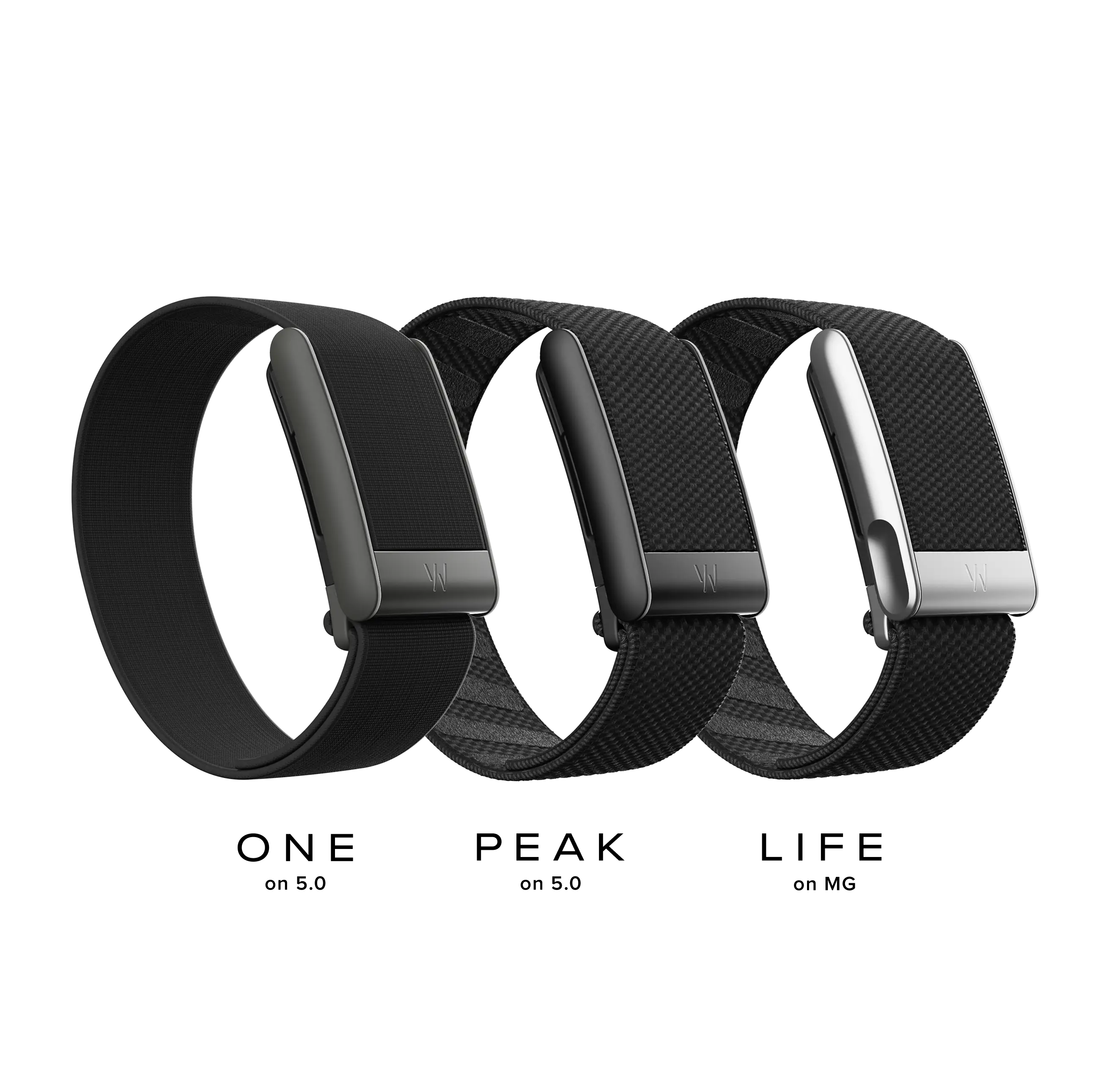
WHOOP 5.0 membership tracks HRV-driven recovery, strain, and sleep—built for athletes who obsess over data
A wearable subscription that monitors heart rate variability (HRV), sleep quality, and training strain with a 14+ day battery. The Three tiers start at $199/yr for basic recovery tracking, up to $359/yr for medical-grade features like ECG and on-demand AFib detection. Includes lifetime warranty and 24/7 support. Women's hormonal insights and VO2 max zones are standard across all plans.
Wearable devices including Whoop show reasonable accuracy for heart rate and HRV measurement against gold-standard ECG in controlled settings, and HRV itself has observational support as a marker of cardiovascular health and training adaptation. However, the proprietary 'recovery' and 'strain' scores lack independent validation in peer-reviewed literature, and no RCTs demonstrate that using Whoop's feedback improves training outcomes, injury prevention, or health metrics compared to standard training. Accuracy degrades in real-world conditions (motion artifact, skin tone variation).
Mechanism
Whoop 5.0 is a wearable device that uses photoplethysmography (PPG) sensors to measure heart rate, heart-rate variability (HRV), skin temperature, and movement, then applies proprietary algorithms to estimate recovery (parasympathetic tone), strain (sympathetic load), and sleep metrics. The device aims to quantify physiological stress and readiness to train by tracking autonomic nervous system state.
“BACKGROUND: Measuring heart rate variability (HRV) through wearable photoplethysmography sensors from smartwatches is gaining popularity for monitoring many health conditions.”
“BACKGROUND: Photoplethysmography (PPG) is a low-cost and easy-to-implement method to measure vital signs, including heart rate (HR) and pulse rate variability (PRV) which widely used as a substitute of heart rate variability (HRV).”
“Validation of heart rate responses in wearable technology devices is generally composed of laboratory-based protocols that are steady state in nature and as a result, high accuracy measures are returned.”
“BACKGROUND: Autonomic regulation of heart rate (HR) as an indicator of the body's ability to adapt to an exercise stimulus has been evaluated in many studies through HR variability (HRV) and post-exercise HR recovery (HRR).”
Caveats
Whoop's core metrics (recovery, strain) are not published in peer-reviewed journals and have not been validated against clinical or performance gold standards. PPG-based HRV is less accurate than ECG-derived HRV, especially during exercise. No randomized trials show that Whoop-guided training decisions improve performance, reduce injury, or enhance recovery versus control. Accuracy varies by skin tone and individual physiology. The subscription model and proprietary algorithms limit independent scrutiny.
✓
Tried it? Verify this find to help others know it works. Members can verify, free to join.
0 comments
Be the first to comment.
EOD publishes opinions and summaries of research about supplements, services, and protocols. It is not medical advice. Consult a qualified healthcare provider before changing your supplement, exercise, sleep, or medication regimen.
Some outbound links on EOD are affiliate links. If you buy through them we may earn a small commission, at no extra cost to you. It never influences what we publish or how it's ranked. Full disclosure.